Friday, July 30, 2010

The EDH Land Deck

So, like I said in the previous post, I wanted to try to port one of my favorite constructed decks to EDH and see how it worked out. Alright, so it’s actually two decks, but they’re pretty similar. 43 Lands from legacy and Eternal Garden, which is a less popular hybrid of 43 Lands and Stax. I’ve always loved land-based strategies, because your engines are typically uncounterable, and that’s just begging to be broken.

I mean, really, the idea behind the land deck is just so elegant. You simultaneously develop your board and draw extra cards with Life from the Loam. Your tutors not only find the card your deck runs on, but also sets up your late game. Sure, you’re vulnerable to a few sideboard cards, but the gameplan is so simple, explosive, and resilient. It draws cards better than blue decks, controls creatures better than wrath decks, and can play the land destruction game with the best of them. To me, the land-based decks are some of the most interesting and awesome creations in recent memory.

So, with that said, I wanted to try to port this idea over to EDH. In order to do that, you’ve really got to try to break down what the land deck is trying to do. You’ve got a couple of components I feel are necessary to focus on in order to make the deck run well:


1. Utility lands. These are the ridiculous non-basics that have been printed over the course of the game. These are your Nomad Stadiums, Horizon Canopies, Bojuka Bogs, and other lands that act like spells.

2. Additional Land Drops. Pretty self-explanatory. Exploration, Manabond, that kind of thing.

3. Draw Engine/tutors. This is typically the combination of Life from the Loam and Cycling lands. I’m going to stray away from that in this deck since you only get one copy of life from the loam, and you want to limit the “vanilla” lands in the deck. Ones that just cycle aren’t that exciting without Life from the Loam or some other way to recur the effect.

4. Recursion. Speaking of recursion, here’s where I run into a little bit of trouble. Life from the Loam and Crucible of Worlds are the first two you think of, but after that, the pickings are pretty slim. Keep reading to see what I could come up with; I’d love to hear if you come up with something better.

5. Resource Denial. Wasteland and Rishadan Port in 43land, you’ve got to expand your horizons a little bit if you’re going to make this plan work in a singleton format, as well as a multiplayer format. This is going to have to extend into ways to neutralize other resources, like spells and creatures, so that you increase the number of dead cards in opponents’ decks.

6. Win Conditions. Man Lands. Worm Harvest. Primeval Titan. You know, win conditions.


So what list did I come up with? Take a look below. I’m pretty sure there’s pretty significant room for improvement. But, this seems like a great place to start. I’m excited to test it out at least. Here’s what I’ve got:
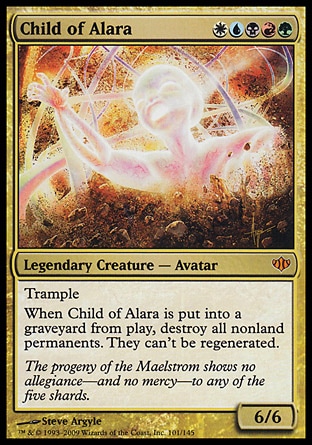

Sacrifice Child of Alara

Diamond Valley

High Market

Miren, the Moaning Well

Control the Board

Smokestack

Braids, Cabal Minion

The Tabernacle at Pendrell Vale

Kor Haven

Ice Floe

Maze of Ith

Mystifying Maze

Prahv, Spires of Order

Solitary Confinement

Hall of Mists

Glacial Chasm

Strip Mine

Wasteland

Ghost Quarter

Dustbowl

Extra Land Drops

Azusa, Lost but Seeking

Exploration

Summer Bloom

Oracle of Mul Daya

Burgeoning

Rites of Flourishing

Budoka Gardener

Tutors and Card Draw

Crop Rotation

Intuition

Gamble

Entomb

Demonic Tutor

Idyllic Tutor

Mystical Tutor

Sylvan Library

Enlightened Tutor

Primeval Titan

Tolaria West

Cephalid Coliseum

Horizon Canopy

Trade Routes

Dark Tutelage

Dark Confidant

Mulch

Horn of Greed

Seer’s Sundial

Ad Nauseam

Recursion

Volrath’s Stronghold

Dance of the Dead

Genesis

Emeria, the Sky Ruin

Academy Ruins

Petrified Field

Tilling Treefolk

Life from the Loam

Crucible of Worlds

Eternal Witness

Holistic Wisdom

Win Conditions

Knight of the Reliquary

Terravore

Avenger of Zendikar

Last Stand

Seismic Assault

Valakut, the Molten Pinnacle

Celestial Colonade

Raging Ravine

Creeping Tar Pit

Lavaclaw Reaches

Vitu-Ghazi, the City Tree

Utility

Prismatic Omen

Urborg, Tomb of Yawgmoth

Whim of Volrath

Warp World

Bojuka Bog

Nomad Stadium

Zuran Orb

Deserted Temple

Vesuva

Ground Seal

Mana Sources

Plateau

Sacred Foundry

Tundra

Hallowed Fountain

Savannah

Temple Garden

Scrubland

Godless Shrine

Taiga

Stomping Ground

Volcanic Island

Steam Vents

Badlands

Blood Crypt

Tropical Island

Breeding Pool

Bayou

Overgrown Tomb

Windswept Heath

Arid Mesa

Wooded Foothills

Misty Rainforest

Verdant Catacombs

Flooded Stand

Scalding Tarn


Apologies about the formatting. I'm still trying to figure out how to copy/paste things from word and whatnot without messing up the formatting on this site. It's kind of obnoxious, but I'm sure I'll get it eventually.


So, the deck plays a total of 57 lands, which is a significantly lower proportion than the legacy variant, but I think most of the spells that have been added are more than worthwhile. If you can think of some lands that I’ve missed, I’d be glad to up the land count. It’s a little disappointing to be play ~60% lands in a land deck. I’d like to add somewhere between 5-10 more lands.

I think that the early game is pretty self explanatory. Hopefully find an exploration effect, play out some lands, draw some cards. Tutor up your methods of protecting yourself from creatures and disrupting players’ mana. The real thing about the deck is the late game. The key here is that Child of Alara can’t wrath the board and return to the command zone to get recast. So, you’ve got to use him as a last minute reset button, instead of running the wrath out early. You’ve got Emeria, the Sky Ruin and Dawn of the Dead to wrath the board repeatedly, or to recur your other utility cards.

So how do you actually win the game? You can lock players under Smokestack/Braids while you wreck their mana with Strip Mine effects. Then, Knight of the Reliquary and Terravore can beat down. Last Stand and Valakut combo with some combination of Prismatic Omen, Urborg, and Whim of Volrath to turn on “domain” esque effects. You’ve got some Manlands and Avenger of Zendikar as additional ways to beat down. Lastly, if you resolve Ad Nauseam, you can just draw infinite lands and wreck people with Seismic Assault; wrathing boards and killing at least 1 or 2 players.

It’s a fun deck to goldfish with; I plan on testing the build out tomorrow (today now) at our weekly EDH night. Seems like it could go pretty well, might go really well. There were a couple of cards I considered adding to the deck that are missing. I could add Future Sight/Magus of the Future to combo with exploration effects to generate absurd amounts of virtual card advantage. If I did that then I’d want to add Sensei’s Divining Top as another Future Sight combo piece, probably in place of Sylvan Library. I kind of want to add more mirage tutors, including the sorcery speed ones. If there are more lands that can be used to control the board, like Maze of Ith/Glacial Flow/Kor Haven, I’d be happy to add those in, if you know about them.

Last thing for this week: I’m looking for ideas for additional decks to look at building. I’m going to list a few ideas I have, and if there’s any interest in those or any other ideas, you could shoot me an email or comment on the post. Hopefully the content I’ve got up so far will generate at least a little bit of interest/criticism/hate mail. Hope to get some feedback! Here are my ideas:

1. Azusa, Lost but Seeking – Landfall

2. Sasaya, Orochi Ascendant – Mono Green ramp

3. Numot, the Devastator – Wildfire

4. Kami of the Crescent Moon – ???

5. Lyzolda, the Blood Witch – Some kind of aggro deck with a lategame based on setting up absurd synergies.

6. Savra, Queen of the Golgari – Stax-ish board control


-Carlos

Carlos.edhblog@gmail.com

Thursday, July 29, 2010

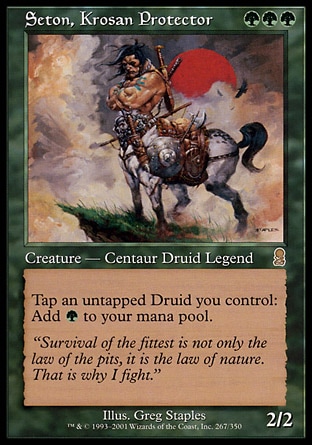
Seton, Krosan Protector

So, first post. Seems appropriate that I talk about my first EDH deck, and my introduction to the format, right? One of my friends introduced me to the format when he brought to decks to regionals last year. The commander he played was Turbo Rafiq of the Many, and he brought a terrible Teferi, Mage of Zhalfir control deck. I got wrecked five or six times between rounds, killed on turn 4 or 5 most of the time, and that was pretty unfortunate.

So, when I got back on campus, I decided to build something a little faster. Rofellos was the first general I wanted to use, which I assume is true for just about everyone. After reading up on him though, I realized just how broken the deck could be, and that isn't really what I wanted. Instead I wanted a deck that could ramp up and start casting bombs early, but still be reasonably fair. I considered a few green ramp legends, Sasaya, Azusa, and Seton. Druid tribal with Seton seemed like the easiest (cheapest) option, since most of the druids in the deck aren't very expensive, and I had most of the pricier cards in my cube anyway. So, here's the list, updated since last year. Okay, so I mostly just added Fauna Shaman.


Lands
Thawing Glaciers
Deserted Temple
Vesuva
Mosswort Bridge
Gaea's Cradle

Tranquil Thicket

Slippery Karst

Blasted Landscape
Scrying Sheets
Mouth of Ronom
25 Snow-Covered Forest

Plan A-Draw Some Cards
Recycle
Tower of Fortunes
Harmonize
Glimpse of Nature
Primordial Sage

Regal Force

Enchantress' Presence

Sylvan Library

Gilt-Leaf Archdruid
Genesis
Argothian Enchantress
Verduran Enchantress

Plan B - Pump your Guys
Kaysa
Gaea's Anthem

Door of Destiny

Eldrazi Monument

Gauntlet of Power

Baru, Fist of Krosa

Concordant Crossroads
Vigor
Beastmaster Ascension
Cloudstone Curio


Plan C - Resource Denial
Kamahl, Fist of Krosa
Masticore
Winter Orb
Storm Cauldron

Tutors
Primal Command
Worldly Tutor
Summoner's Pact
Survival of the Fittest
Sylvan Scrying
Abundance
Sensei's Divining Top
Tooth and Nail
Natural Order
Lurking Predators
Fauna Shaman

Druids
Boreal Druid
Civic Wayfinder
Devoted Druid
Drui Lyrist
Elvish Archdruid
Elvish Harbinger
Elvish Pioneer
Farhaven Elf
Fyndhorn Elves
Fyndhorn Elder
Heart Warden
Joraga Treespeaker
Juniper Order Druid
Ley Druid
Llanowar Druid
Llanowar Elves
Mul Daya Channelers
Nantuko Cultivator
Nantuko Vigilante
Priest of Titania
Rofellos, Llanowar Emissary
Seedguide Ash
Zoologist
Yavimaya Elder
Wirewood Channeler
Chameleon Colossus
Argothian Druid

Other Ramp
Vitalize
Mana Reflection


So what does the deck do. The list is broken down into three major categories which represent your gamplans. The first is to draw enough cards that you don't mind getting your creatures wrathed away. Drawing enough extra cards also helps you find combo pieces, and your resource denial cards. Seton allows you to continue to develop your board even under a Winter Orb or Storm Cauldron, which makes those cards absolutely busted for you. You also have the option of just vomiting a bunch of druids onto the board, and making them huge with your Overrun/Glorious Anthem effects.

So how do you actually win? You've got a couple of combos that can win the game, most of which revolve around Masticore. Masticore combos with Vigor and with Kamahl. With kamahl, it's an Armageddon for players that aren't you, and with Vigor, you get to do ridiculous combat tricks to pump all of your druids repeatedly. You can also steal everyone's lands with Gilt-Leaf Archdruid.

So, the problem with this deck ended up being that you don't have enough ways to win the game. You can make your guys huge, but then they get wrathed. You can draw a lot of cards, but still whiff on the pieces you need to put pressure on the rest of the table. The games that this deck did win all involved an early Storm Cauldron or Winter Orb while dropping a ton of guys onto the board with Seton.

So, what did I like about this deck? I liked the ability to add "draw a card" to most of your creatures/enchantresses. I liked disrupting other players mana while developing my board with Seton. I liked the ramp engine that is Thawing Glaciers and effects that untap lands. I liked the synergistic combo finishes. As a rule, I love finding the cool little synergies between cards, and showing them off in EDH games. As long as the combo isn't infinite, I'm a fan of it.

Really, I think the deck would be improved by adding some more Naturalize style effects, preferably attached to an elf, like Viridian Zealot. You really don't have very many ways to interact with your opponents outside of the combat step, which is a real issue for the deck.
All told, this is a really fun casual deck to play. It's not as powerful as the straight up Elfball combo decks some people build, but sometimes you get that perfect storm of cards and go nuts. Definitely not something I'd build again, since it really doesn't know what role it wants to play. Sometimes it wants to go druid aggro, sometimes it wants to combo off, and sometimes it wishes it could play control.

So, that's all I've got on Seton for now. If you've got any comments or recommendations with regard to this decklist, let me know. If you've got any legends or decklists in particular you'd like to have looked at, shoot me an email. I think next time I might try to port one of my favorite constructed decks to EDH.

-Carlos
Carlos.edhblog@gmail.com

Wednesday, July 28, 2010

Introduction

Hey there.

So, I'm a pretty typical college student who's been bitten by the EDH bug. I've been playing magic for about 10 years, off and on, mostly casual stuff until the last four years or so. So what qualifies me to write about magic on the internet? Nothing at all. All I have to bring to the table is a real interest in magic, particularly Elder Dragon Highlander, and interesting and unique challenge that the format presents in deckbuilding.

On the off chance some of you are unfamiliar with the format, here's how it works. You choose a legendary creature to be your general. Now, you choose 99 other cards which are in your general's colors, and you're ready to go. Okay, that isn't exactly true. You have to choose 99 cards (including lands) which only include mana symbols in your general's casting cost. Now, here's the key thing: you will, typically, always have the ability to cast your general, regardless of how many times it dies.

Think about that for a second. You will always have access to your general. That's crazy good! Can you imagine how good standard decks would be if they always had Jace, the Mindsculptor in their hand? What about always having Vengevine or Bloodbraid Elf, or anything else like that? The ability to always have access to your general is absurdly powerful, and takes the concept of building your deck around a card to a whole Next Level, if you'll pardon the pun. There are two ways I like to think about building around a general.

1. You can build your deck in such a way to maximize the effectiveness of your general. Okay, so what does this mean? It means a deck where the general is something of a combo piece. Think of, say, Arcum Dagsson. Most of an Arcum deck is designed in such a way to maximize his ability, so that you have a repeatable Tinker effect. So you run a lot of high cc, powerful artifacts, and a lot of small artifact creatures that ramp you up to a turn 2 or 3 Arcum.

2. You can choose a general such that it provides an effect that your deck needs to have access to at all times. Think of a mono-black control, with a general like Drana, Kalastria Bloodchief or Xiahou Dun, the One-Eyed. The deck can pretty much stand on its own, with the general only providing continuous access to a win condition, spot removal, or recursion as necessary.

3. Yes, I know I said there were two ways to build around a general. There is a third, but its one that I'm not really a fan of, johnny that I am. You can choose your general such that it gives you access to the colors you want to play, and provides a generic, powerful effect. These are decks like five color control, which just uses its general for a combo finish (Sliver Queen), or a Rafiq of the Many deck that's really just U/G/W tempo or control with Rafiq thrown is as the best available legend in those colors.


So, I guess the better question is: what do I plan to accomplish with this blog? Really I just want to be able to discuss different ideas for decks I have. I hope that, by doing that, it'll provide points of discussion and critique to further develop different ideas I have for the format, and hopefully provide inspiration and advice to other people who are as interested in the format as I am.

So, with that said, if you've got any ideas you'd like to share or see discussed, or any decks you want critiqued, shoot me an email; I'd be glad for the opportunity.

-Carlos
carlos.edhblog@gmail.com